
While many associate poker with smoky backrooms and intense player-versus-player showdowns, the digital felt offers a different challenge entirely. The JILILIVE poker table games pit you directly against the dealer, blending classic poker hand rankings with the fast-paced action of casino table gaming. These games aren’t about bluffing an opponent off a pot; they are about understanding probabilities, making mathematically sound decisions, and managing your bankroll against a fixed house edge.
Understanding JILILIVE Poker Table Games
Casino poker is a fundamentally different beast from its PvP counterpart. The opponent is always the house, and the rules are structured to give the casino a small, consistent mathematical advantage over the long run. Your job isn’t to outwit a table of rivals but to play the optimal strategy for the specific game variant you’ve chosen.
What Makes Casino Poker Unique?
Instead of posting blinds and betting into a communal pot, you place an ante to receive a hand. After seeing your cards (and sometimes the dealer’s), you must decide whether to make an additional “Play” or “Raise” bet to continue, or to fold and forfeit your ante. The dealer’s hand must often meet a minimum strength, known as “qualifying,” to proceed. This creates a unique dynamic where you’re betting on your hand’s strength against a predictable set of house rules, not the unpredictable whims of another player.
Popular Poker Variants Available
The platform offers several popular formats, each with its own rhythm and strategy. The most common you’ll encounter are games derived from Texas Hold’em, such as Casino Hold’em or Ultimate Texas Hold’em, and the rapid-fire Three Card Poker. Each variant has distinct rules, payout structures, and optimal strategies that must be learned independently to minimize the house advantage.
Essential Rules for Each Poker Table Game
Mastering the specific rules for each game is non-negotiable. Jumping in without knowing the dealer qualifying rules or the proper time to raise is the fastest way to drain your bankroll. Each decision carries a direct cost and potential return based on a fixed pay table.
Texas Hold’em: Basics and Betting Rounds
In casino versions of Hold’em, you place an Ante bet. You and the dealer each receive two hole cards. You then see the three-card flop. At this point, you must decide: fold your hand and lose the ante, or place a Play bet (typically 2x your ante) to see the turn and river. There’s no further betting. Your five-card hand is compared to the dealer’s. The dealer usually needs a pair of 4s or better to qualify; if they don’t, your Play bet pushes and the Ante pays out according to the pay table.
Omaha Poker: Hand Strengths and Strategy Differences
While less common as a casino table game, the core principle of Omaha is crucial for any poker player to understand. The key difference is that players receive four hole cards instead of two. To make a five-card hand, you must use exactly two of your hole cards and exactly three of the five community cards. This rule dramatically increases the number of potential hand combinations and often leads to much stronger winning hands compared to Hold’em.
Three Card Poker: Odds and Optimal Play Decisions
This is one of the most popular casino poker variants due to its simplicity. You have two independent bets: the Ante/Play bet against the dealer, and the optional Pair Plus side bet. The Pair Plus wager pays out based only on the strength of your three cards, regardless of what the dealer has. For the main game, the optimal strategy is simple and has been mathematically solved: you should always make the Play bet if your hand is Queen-6-4 or better, and fold anything weaker. Deviating from this simple rule directly increases the house edge against you.
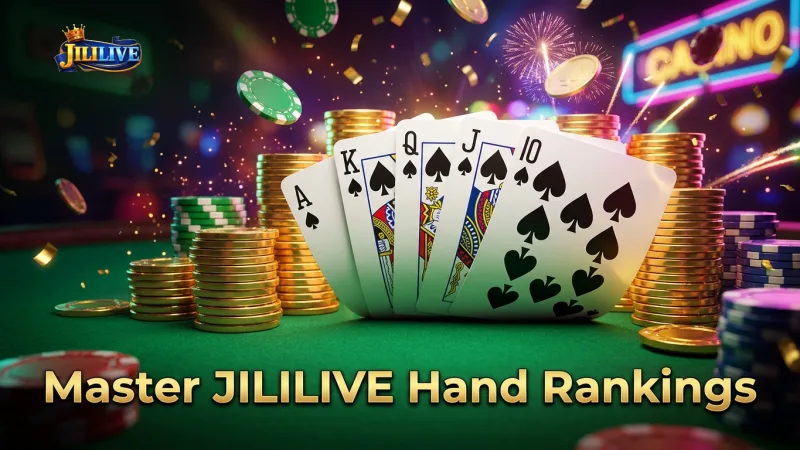
Master essential hand rankings for JILILIVE poker table games success.
Key Poker Concepts and Terminology
Understanding the language of the game is as important as knowing the rules. From hand rankings to betting structures, getting the fundamentals right provides the foundation for making better decisions at the table.
Hand Rankings: Knowing What Beats What
The hierarchy of poker hands is universal across almost all variants. Memorizing this order is the first step for any new player. A lack of understanding here can lead to costly mistakes, like overvaluing two pair when a flush is possible on the board.
| Hand | Description |
|---|---|
| Royal Flush | A, K, Q, J, 10, all of the same suit. The best possible hand. |
| Straight Flush | Five cards in sequence, all of the same suit (e.g., 8-7-6-5-4 of hearts). |
| Four of a Kind | Four cards of the same rank (e.g., four Kings). |
| Full House | Three cards of one rank and two cards of another rank. |
| Flush | Any five cards of the same suit, not in sequence. |
| Straight | Five cards in sequence, but not of the same suit. |
| Three of a Kind | Three cards of the same rank. |
| Two Pair | Two cards of one rank, two cards of another rank. |
| One Pair | Two cards of the same rank. |
| High Card | If no one has a pair or better, the hand with the highest single card wins. |
Understanding Antes, Payouts, and House Edge
The Ante is your mandatory buy-in for the hand. Payouts are based on a fixed table, often with bonuses for very strong hands like a straight flush or royal flush. Every bet you make carries a built-in house edge—the mathematical advantage that ensures the casino’s long-term profitability. For example, the Ante bet in Three Card Poker carries a house edge of around 3.37%, while the Pair Plus side bet is typically around 2.32%, though this can vary. Your goal is to use optimal strategy to keep that edge as low as the game rules allow. For more information, you can find a complete guide to all JILILIVE poker table games rules on our platform.

Practice new JILILIVE poker table games rules before you bet.
Strategy Fundamentals for Poker Success
Success in casino poker isn’t about luck. It’s about disciplined application of proven strategies. Over time, players who make the correct mathematical plays will perform better than those who rely on gut feelings.
Bankroll Management for Table Games
This is the most critical skill. Before you sit down, decide on a maximum amount you are willing to lose for that session and stick to it. A common approach is to set your standard bet size at 1-2% of your session bankroll. This discipline prevents a single bad run from wiping you out and allows you to withstand the natural variance of the games. Chasing losses is a losing proposition. Period.
Playing the Dealer, Not Your Emotions
In casino poker, you’re not trying to deduce if an opponent is bluffing. You are playing against a fixed set of rules. Your only “read” is on the dealer’s visible cards and the dealer’s qualifying requirements. Your decisions must be based on the strength of your hand relative to the probability of the dealer making a qualifying hand that you can beat. Emotion has no place in this calculation.
When to Fold, Call, or Raise Effectively
Every poker variant has specific strategic thresholds. As mentioned, the Q-6-4 rule in Three Card Poker is a perfect example. In Casino Hold’em, you should almost always make the Play bet with any pair, any ace-high or king-high hand, or any flush or straight draw. Folding these hands is a long-term strategic error that gives up too much value.
Play JILILIVE poker table games responsibly by setting clear limits.
Playing Safely: Responsible Gaming at JILILIVE
Enjoying poker table games requires a safe and controlled environment. Our team believes that responsible gaming is the bedrock of a positive player experience. It is essential for all players to understand the risks and utilize the tools available to them.
Setting Limits for Your Play
The most effective way to ensure a safe experience is to set personal limits before you start playing. Use the on-platform tools to set deposit limits, loss limits, and session time reminders. These features are designed to empower you to stay within your budget and play responsibly. This should only be considered entertainment for adults (18+), and you should only ever wager funds you can comfortably afford to lose.
Recognizing and Avoiding Problem Gaming
Gaming should be a fun pastime, not a financial necessity. If you find yourself spending more time or money than intended, chasing losses, or if gaming is negatively impacting your life, it’s crucial to take a step back. Support and resources are available for anyone who feels their gaming habits are becoming a problem.
Final Strategic Considerations for Poker Tables
Side bets, like the Pair Plus in Three Card Poker or progressive jackpots in Caribbean Stud, can offer tempting, lottery-style payouts. However, our trading desk analysis consistently shows these bets carry a significantly higher house edge than the main game. They can be a fun diversion, but they are designed to drain a bankroll faster over time. If your goal is to maximize your play time and make strategically sound decisions, focus your wagers on the primary Ante/Play bets where the house edge is lowest.
Remember, every casino game has a built-in advantage for the house. There are no secret systems or guaranteed winning strategies. The only thing you control is your own decision-making process and your bankroll. Play smart, play within your limits, and understand that winning sessions are great, but losses are an inevitable part of the game’s statistical makeup.
